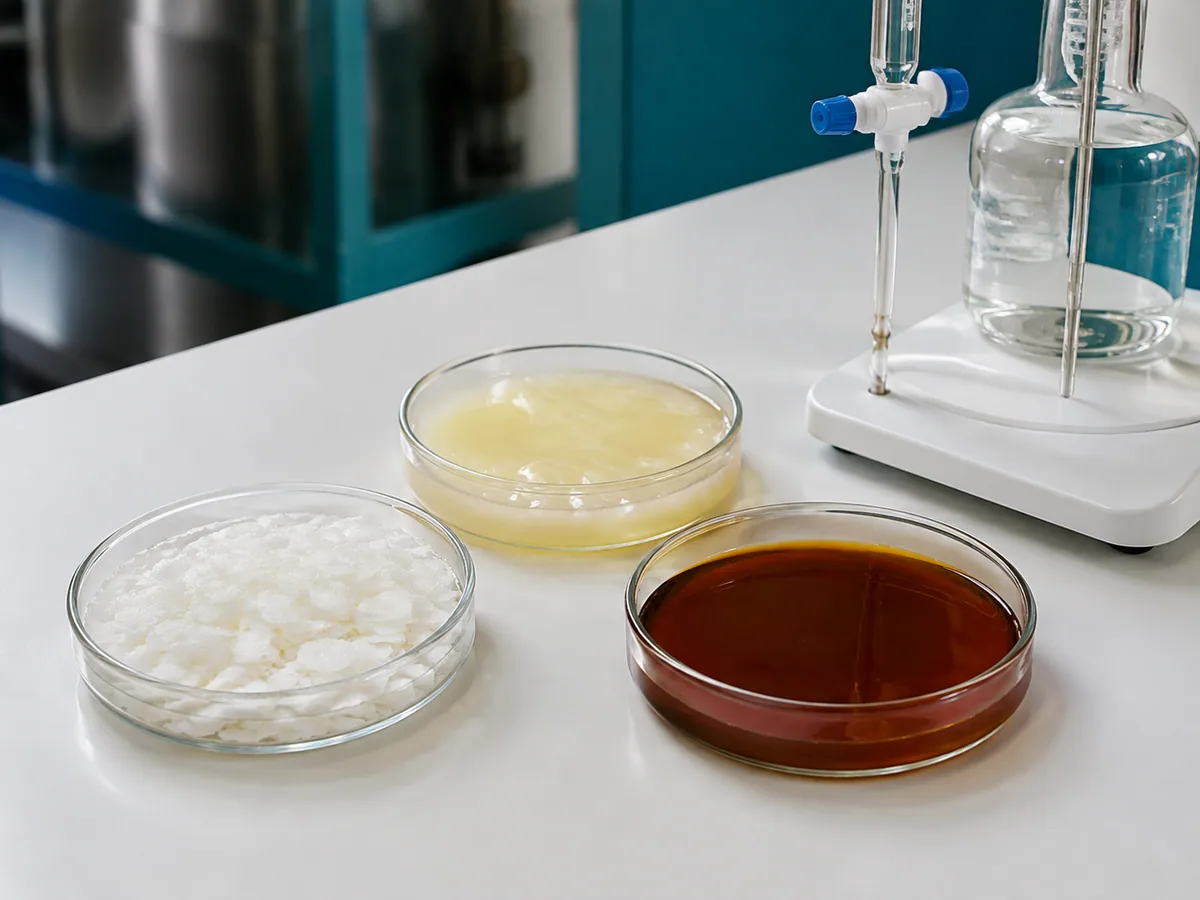
Stearic acid is one of the most widely used oleochemicals, found in tyres, PVC, candles, creams, soaps and lubricants. Yet the product sold as stearic acid is rarely pure stearic acid, and two lots with the same name can behave very differently in a process. This guide explains what commercial stearic acid is, how it is made, how the common grades differ, which specification parameters matter, and how to choose a grade for your application.
What commercial stearic acid is
Stearic acid is octadecanoic acid, a saturated fatty acid with 18 carbon atoms (C18:0) and the formula C18H36O2. Pure stearic acid melts at about 69 °C. The material traded as stearic acid, however, is almost always a blend of stearic acid and palmitic acid (C16:0), with small amounts of myristic, arachidic and other fatty acids. In a typical palm-based triple-pressed grade, palmitic acid makes up roughly 50–60% and stearic acid roughly 40–50%.
The C16/C18 ratio matters because the two acids crystallise together. Blends solidify at lower temperatures than either pure acid, typically with a titre of about 53–57 °C, and the ratio influences hardness, crystal structure and texture in the finished product.
A note on terminology: in the candle trade, stearin often means stearic acid, while in the oils and fats trade it means the solid fraction of an oil, as in palm stearin. The two are different materials, so check which one a specification refers to.
How stearic acid is made
Most stearic acid starts from palm oil, palm stearin or other vegetable oils, or from tallow. The main steps are:
- Fat splitting: the oil or fat is hydrolysed with water at high temperature and pressure, giving mixed fatty acids and a glycerine-water stream known as sweet water.
- Hydrogenation: the fatty acids are hydrogenated over a catalyst to saturate double bonds, converting oleic and linoleic acids into stearic acid and lowering the iodine value.
- Distillation and fractionation: the acids are distilled to remove colour bodies and residues, and can be fractionated to adjust the C16/C18 ratio or to produce high-purity grades.
- Finishing: the molten product is formed into beads, flakes or powder, or shipped molten.
Glycerine from the splitting step is refined separately; our guide to glycerine grades explains the options.
Single, double and triple pressed grades
The pressed names date from the time when fatty acids were crystallised into cakes and pressed hydraulically to squeeze out liquid oleic acid. Each pressing removed more unsaturated acid, so triple-pressed stearic acid had the lowest iodine value and the best colour. Modern plants reach the same result by hydrogenation and distillation, but the names survive as quality classes.
Trade codes such as 1801, 1838 and 1842 are producer and trade designations rather than a formal standard. They are widely used for palm-based grades, with 1801 usually offered as a single-pressed or rubber grade and 1838 and 1842 as higher-purity pressed grades. Our comparison of single, double and triple pressed stearic acid sets out the differences in detail.
High-purity and regulated grades
Beyond the pressed grades, fractionation produces stearic acid with a much higher C18 content, often sold as 1865 or as 90% or higher grades, for applications that need higher melting points or specific crystal behaviour. Pharmaceutical grades are defined by pharmacopoeia monographs; the European Pharmacopoeia, for example, describes types 50, 70 and 95 according to their stearic acid content. Food-grade fatty acids are an authorised additive (E 570) in the EU. These grades need documentation that covers the specific product and manufacturing site, so do not assume them from the name alone.
The specifications that matter
Acid value and saponification value. Acid value, in mg KOH/g, measures free carboxylic acid and determines how much alkali is needed for neutralisation. For palm-based stearic acid it is typically around 205–212. Saponification value also includes combined fatty acids; a large gap between saponification value and acid value points to unsplit glycerides or esters.
Iodine value. Iodine value, in g I2/100 g, measures residual unsaturation. Low values mean better colour stability, less odour development and more predictable behaviour on heating. Triple-pressed grades are typically specified at 1 or below, often 0.5 maximum.
Titre and melting behaviour. Titre is the solidification point of the fatty acids, in °C. It depends mainly on the C16/C18 ratio and on residual unsaturation.
Fatty acid composition. Measured by gas chromatography, the composition shows the C16 and C18 content and minor acids. It is the best single predictor of how a grade will crystallise.
Colour. Colour is reported on the Lovibond scale or as APHA (Hazen) units, sometimes with a heat-stability test. Colour matters most in cosmetics, candles and light-coloured plastics.
Moisture, ash and unsaponifiable matter. These indicate processing quality and residues; pharmaceutical and cosmetic buyers may also specify heavy metals.
Typical specification ranges
The figures below are indicative ranges for palm-based triple-pressed stearic acid, not a standard. Always compare the actual specification and certificate of analysis for the offered lot.
- Acid value: about 205–212 mg KOH/g.
- Saponification value: about 206–213 mg KOH/g.
- Iodine value: 1 maximum, often 0.5 maximum.
- Titre: about 54–56 °C.
- Composition: C16 about 50–60%; C18 about 40–50%.
- Colour: low, typically specified on the Lovibond or APHA scale.
- Physical form: beads, flakes or powder.
Applications
Rubber. Stearic acid and zinc oxide form the activator system for sulphur vulcanisation, usually at around 1–3 phr (parts per hundred rubber). It also helps process the compound and disperse fillers. Rubber compounders often use single-pressed grades. See our rubber and plastics page.
Plastics and PVC. Stearic acid is an internal and external lubricant and a release agent, and it is the raw material for calcium and zinc stearates used in PVC stabiliser systems and as acid scavengers in polyolefins.
Personal care. Partly neutralised stearic acid forms the base of vanishing creams, gives pearlescence and structures deodorant sticks and shaving creams. Triple-pressed grades with low colour and odour are preferred; see our personal care page.
Candles. Stearic acid hardens paraffin blends, improves opacity and mould release, and is used on its own in stearin candles. Low iodine value helps prevent yellowing.
Soap. Stearic acid adds hardness and a creamy, stable lather to bar soaps and is a key raw material for shaving soaps.
Other uses. Lubricants and greases, textile auxiliaries, metallic soaps, esters such as glycerol monostearate, crayons, polishes and mould-release agents.
Choosing a grade
- Start from the property that matters: colour and odour stability, crystallisation, reactivity or cost.
- Do not over-specify: a rubber compound rarely needs a cosmetic grade, but a white candle or a cream does.
- Specify the C16/C18 ratio where texture or crystal structure matters, not just the grade name.
- Ask for several recent certificates of analysis to judge lot-to-lot consistency.
- Trial the grade in your own process before switching production.
Common specification pitfalls
- Buying on the code alone. Two lots sold under the same grade code can differ in iodine value, colour and composition. Specify the limits you need.
- Ignoring the C16/C18 ratio. It changes crystallisation, hardness and texture, even when every other figure matches.
- Treating typical values as limits. A figure labelled typical is an average, not a guarantee. Contract on maximum and minimum values.
- Overlooking the feedstock. Palm-based and tallow-based grades can meet the same analytical limits but not the same origin, religious or sustainability requirements.
- Skipping the trial. A new source can behave differently in your process even when its certificate of analysis matches the old one.
Packaging, storage and handling
Stearic acid is usually supplied in 25 kg bags on pallets, in larger bulk bags, or molten in heated tankers for large users. Beads flow freely and suit automatic dosing; flakes are common and economical; powder disperses fastest. Store bags in a cool, dry place away from heat and direct sunlight to prevent caking and discolouration. Fine powder can form combustible dust clouds, so control dust and earth equipment. Stearic acid is not generally classified as hazardous for transport, but molten material causes burns; follow the safety data sheet.
For documentation, ask for the specification, a certificate of analysis for each lot, the safety data sheet and an origin declaration that states the feedstock (palm-based, other vegetable or tallow). Where you need sustainable palm, halal, kosher or pharmaceutical certification, ask for the certificate scope with your quotation. To discuss a grade, see our palm stearic acid page.
Frequently asked questions
Is stearic acid the same as stearin?
Not always. In the candle trade stearin usually means stearic acid, but in the oils and fats trade it means the solid fraction of an oil, such as palm stearin. Check the specification to see which is meant.
Why is commercial stearic acid a blend of C16 and C18 acids?
Natural fats contain both palmitic and stearic acids, and separating them completely is costly. Most applications work well with a blend, so the ratio is controlled rather than eliminated.
What does triple pressed mean today?
It describes a quality class with a very low iodine value and good colour, typically an iodine value of 1 or less. Modern producers reach it by hydrogenation and distillation rather than hydraulic pressing.
Which grade is used in rubber?
Rubber compounders commonly use single-pressed or rubber grades, often traded under codes such as 1801. Light-coloured or high-specification compounds may use double- or triple-pressed grades.
Is all stearic acid vegetable-derived?
No. Stearic acid made from palm or other vegetable oils is vegetable-derived, but some grades are made from tallow. Ask for an origin declaration, and for the certificate scope if you need sustainable palm certification.
How should stearic acid be stored?
Keep bags closed in a cool, dry place away from heat and sunlight, and rotate stock. Heat causes caking and prolonged high temperatures darken the product.