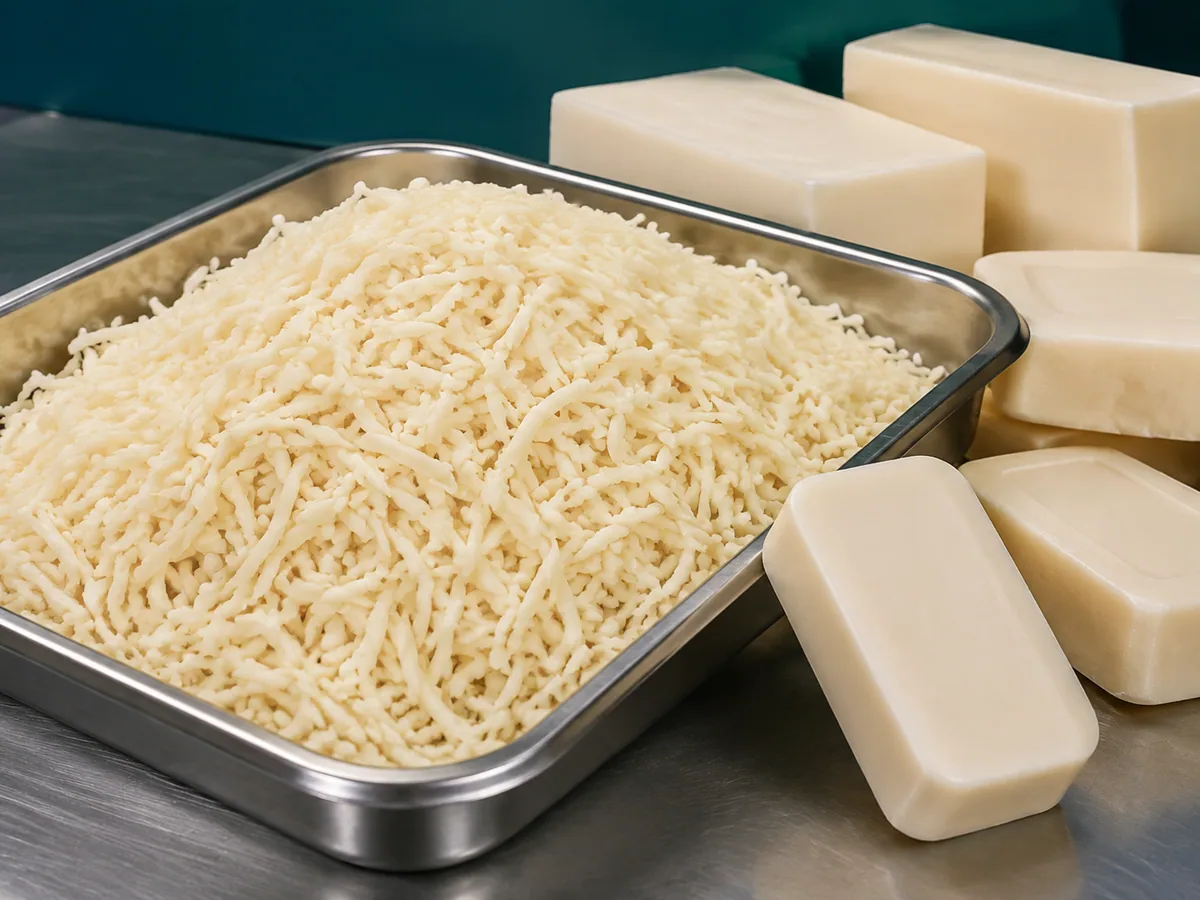
Soap noodles are the starting point for most bar soap made by finishing plants. Instead of saponifying oils in-house, a finisher buys ready-made soap base in noodle form, adds perfume, colour and other ingredients, and mills, plods and stamps the bars. The quality of the noodles therefore sets the limits of what the finished bar can achieve. This article explains the terms used to buy them: total fatty matter (TFM), blend ratios such as 80/20 and 90/10, and the difference between toilet and laundry grades.
What soap noodles are
Soap noodles are sodium salts of fatty acids, the basic material of soap, dried and extruded into short pellets. They are made either by saponifying oils and fats with caustic soda, in batch kettles or continuous plants, or by neutralising distilled fatty acids. The wet soap is vacuum-dried to the target moisture and extruded as noodles, which are easy to store, weigh and feed into a finishing line.
In finishing, noodles are mixed with perfume, colour, whitener and additives in an amalgamator, refined on roll mills, compacted in a plodder, extruded as a bar, cut and stamped.
What TFM means
Total fatty matter is the total amount of fatty material, mostly fatty acids, that can be recovered from the soap by splitting it with mineral acid, expressed as a percentage of the product's weight. It is the most widely used measure of soap content: a higher TFM means more soap and less water, salt or filler.
TFM is quoted both for noodles and for finished bars. Some national standards grade toilet soaps by minimum TFM; India's toilet-soap standard, for example, requires at least 76% TFM for its top grade. Finished bars usually have a slightly lower TFM than the noodles they were made from, because perfume, colour and additives dilute the soap.
80/20 vs 90/10: what the ratio means
The ratio describes the blend of non-lauric to lauric fatty matter. The non-lauric part is usually palm oil or palm stearin, or tallow in animal-based soaps; the lauric part is palm kernel oil or coconut oil.
- Lauric fatty acids (C12–C14) give quick, open lather and good solubility, but too much makes a bar soft and quick to wear.
- Palm or tallow fatty acids (C16–C18) give hardness, a dense, creamy lather and slower wear, but lather more slowly on their own.
An 80/20 blend is the common choice for toilet soap, balancing hardness with lather. A 90/10 blend lathers less readily and is more economical, so it is widely used for laundry soap and budget toilet soap. Blends with more lauric content, such as 70/30, are used where rich lather matters most. Ask for the fatty acid composition as well as the ratio, because the same ratio can be made from different oils.
Toilet vs laundry soap noodles
Toilet soap noodles are made for personal-care bars. They have high TFM, commonly around 76–80%, low free alkali, low salt, a white colour and a neutral odour that will not interfere with perfume.
Laundry soap noodles are made for bars used to wash clothes and household items. They tolerate lower TFM, often around 60–72%, and the finished bars may contain fillers and builders such as sodium silicate, sodium carbonate or mineral fillers. Colour and odour limits are wider, and the cost per tonne is lower.
Specialty noodles, such as bases for translucent or glycerine-rich bars, use their own blends and are specified separately.
Typical specifications at a glance
These figures are indicative; exact limits vary by producer and grade.
- TFM: toilet grades about 76–80%; laundry grades about 60–72%.
- Moisture: toilet grades about 12–15%, balanced with TFM.
- Free caustic alkali (as NaOH): typically 0.05–0.1% maximum for toilet grades.
- Sodium chloride: typically below about 0.5–1%.
- Glycerine: varies with the manufacturing route; noodles from fatty acid neutralisation contain little unless it is added back.
- Iodine value: palm-based 80/20 blends typically around 35–50.
- Colour and odour: white and neutral for toilet grades, wider limits for laundry.
- Additives: chelating agents such as EDTA or etidronic acid and an antioxidant are often included to slow rancidity.
Common quality problems
- Cracking: noodles that have dried out in storage, or a blend that is too hard for the process.
- Mushiness: high lauric content or too much moisture in the finished bar.
- Rancidity and orange spots: oxidation of unsaturated fatty acids, accelerated by trace metals and heat; chelating agents and antioxidants help.
- Colour drift: poor raw-material quality, overheating or iron contamination.
Storage and handling
Soap noodles are usually packed in 25 kg bags with an inner liner, or in larger bulk bags, and shipped in containers. Store them dry, out of direct sun and away from heat, which can make them sticky. Keep bags closed: noodles that lose moisture produce cracked bars. Check moisture on arrival, rotate stock first in, first out, and keep batch numbers traceable to finished production.
Documents to ask for
Ask for a specification, a certificate of analysis for each lot and the safety data sheet. Toilet soap sold to consumers is a cosmetic product in the UK and EU, so your safety assessor will need raw-material information. For sustainable palm, halal or other claims, ask for the certificate scope with your quotation. For bars that also use stearic acid for hardness or pearlescence, see our stearic acid guide. To discuss grades, see our soap noodles page and our soap and detergents sector page, or review palm kernel oil as a lauric source for in-house saponification.
Frequently asked questions
What does TFM stand for?
Total fatty matter. It is the percentage of fatty material recovered when the soap is split with mineral acid, and it is the main indicator of soap content.
What is the difference between 80/20 and 90/10 soap noodles?
80/20 contains more lauric oil than 90/10, so it lathers more quickly and fully. 90/10 is harder-wearing and more economical but lathers less readily, so it is common in laundry and budget toilet soap.
Can laundry noodles be used for toilet soap?
Not usually. Laundry noodles have lower TFM, wider colour and odour limits and may contain fillers, so they do not meet the quality expected of personal-care bars.
Why do finished soap bars crack?
Common causes are noodles that have dried out in storage, an overly hard blend, or plodding at the wrong temperature. Store noodles sealed and check moisture on arrival.
Are soap noodles vegetable-based?
Palm-based noodles are vegetable-based; others use tallow. Ask for an origin declaration and for the certificate scope if you need certified sustainable palm.